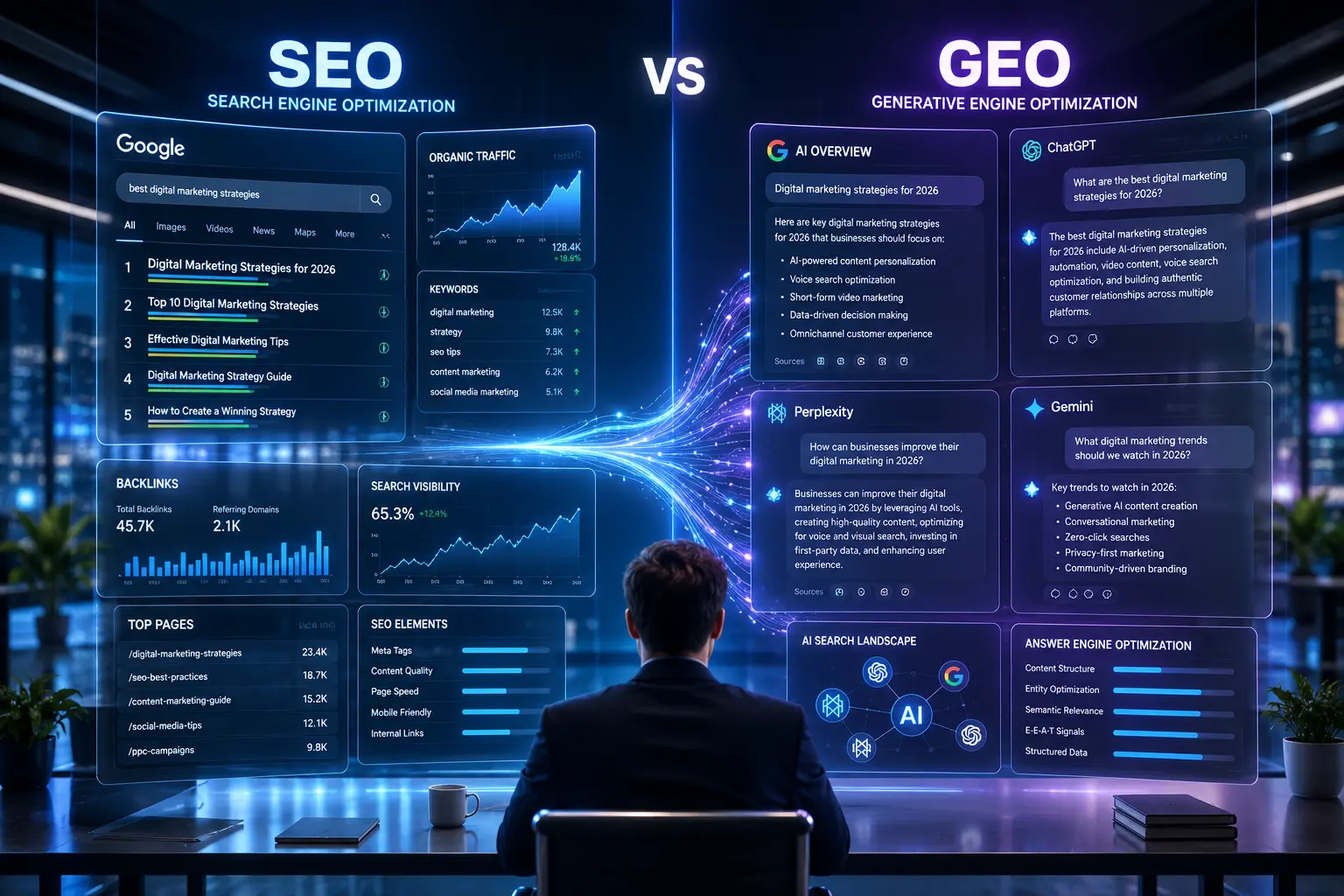
GEO vs SEO refers to two different approaches to online visibility. SEO focuses on improving rankings in traditional search engines like Google, while GEO (Generative Engine Optimization) helps content appear in AI-generated answers from platforms such as ChatGPT, Perplexity AI, Gemini AI, and Google AI Overviews. In 2026, businesses need both strategies to maximize search visibility and organic traffic.
Key Takeaways
- SEO helps websites rank in traditional search engine results.
- GEO focuses on visibility within AI-generated answers.
- Google AI Overviews, ChatGPT Search, Gemini AI, and Perplexity AI are changing how users discover information.
- Structured data and topical authority play a major role in GEO success.
- Businesses should combine SEO and AI search optimization rather than choosing one over the other.
- GEO enhances visibility in conversational search environments.
- SEO remains essential for driving long-term organic traffic.
What Is GEO (Generative Engine Optimization)?
Generative Engine Optimization (GEO) is the process of optimizing content so AI-powered search platforms can discover, understand, and reference it when generating answers.
Unlike traditional search engines that display a list of links, AI platforms often provide direct answers. These AI-generated answers pull information from multiple trusted sources and present summarized responses to users.
As more people use ChatGPT Search, Gemini AI, Perplexity AI, and Google AI Overviews, businesses must ensure their content is structured and authoritative enough to be cited by these systems. These platforms rely on large language models (LLMs) to analyze information, understand context, and generate relevant responses for users.
How Generative Engine Optimization Works
AI systems analyze:
- Content relevance
- Topical authority
- Entity relationships
- Structured data
- Source credibility
Instead of focusing solely on rankings, GEO aims to increase the likelihood of being referenced within AI-generated responses.
Why GEO Matters in 2026
Consumer search behavior is rapidly evolving. Users increasingly expect immediate answers instead of browsing multiple websites.
This shift makes AI search optimization a critical part of modern digital marketing strategies.
Platforms Driving GEO Growth
Several major platforms are accelerating GEO adoption:
- ChatGPT Search
- Google AI Overviews
- Gemini AI
- Perplexity AI
These tools are becoming primary information sources for millions of users worldwide.
What Is SEO?
Search Engine Optimization (SEO) is the process of improving a website’s visibility in search engine results pages (SERPs).
The goal is to attract qualified visitors by ranking higher for relevant keywords. Many businesses invest in SEO services in Pakistan to improve rankings, strengthen online visibility, and drive consistent website traffic.
SEO remains one of the most effective methods for generating sustainable organic traffic.
Core Components of SEO
SEO typically includes:
- On-page optimization
- Technical SEO
- Content marketing
- Link building
- User experience optimization
Together, these elements help search engines understand and rank content.
How SEO Generates Organic Traffic
When users search for specific topics, products, or services, search engines display relevant webpages.
Higher rankings often lead to increased clicks, traffic, and conversions.
Why SEO Still Matters
Despite the rise of AI-powered search, traditional search engines continue to handle billions of searches daily.
Businesses that ignore SEO risk losing valuable search visibility and revenue opportunities.
GEO vs SEO: Key Differences
Although GEO and SEO share similar objectives, their optimization methods differ significantly.
| Factor | SEO | GEO |
|---|---|---|
| Primary Goal | Search Rankings | AI Citations & References |
| Target Platform | Google, Bing | ChatGPT, Gemini AI, Perplexity AI |
| User Experience | Search Results Pages | AI-Generated Answers |
| Success Metric | Rankings & Traffic | Mentions & Citations |
| Optimization Focus | Keywords & Backlinks | Context, Authority & Structure |
| Content Format | Search-Friendly Content | AI-Friendly Content |
Search Intent Differences
SEO primarily targets search engine users who browse multiple results.
GEO focuses on users seeking instant AI-generated answers.
Content Structure Requirements
AI systems prefer:
- Clear headings
- Direct answers
- Context-rich content
- Strong topical coverage
These elements help improve AI understanding.
Measurement and KPIs
SEO measures:
- Keyword rankings
- Organic traffic
- Click-through rates
GEO measures:
- AI citations
- Brand mentions
- Presence within AI-generated answers
Note: Businesses should not treat GEO as a replacement for SEO. Instead, GEO should be integrated into an existing SEO strategy to maximize overall search visibility.
What Is the Difference Between GEO and SEO?
The main difference between GEO and SEO is their target environment.
SEO helps users find your website through search engine rankings.
GEO helps AI systems understand, trust, and cite your content when generating answers.
While SEO drives clicks, GEO increases brand exposure within AI-generated responses.
How to Rank in AI Search Results
Businesses looking to improve AI visibility should focus on authority, accuracy, and content quality.
Build Topical Authority
Create comprehensive content clusters around core topics.
The more expertise your website demonstrates, the more likely AI systems are to trust your content.
Use Structured Data
Structured data helps search engines and AI systems understand content relationships.
Schema markup can improve content discoverability and context.
Create Answer-Focused Content
AI platforms favor content that directly answers user questions.
Adding concise explanations, FAQs, and clearly organized sections increases visibility opportunities.
Should Businesses Invest in GEO or SEO?
A common question businesses ask is whether they should prioritize GEO or SEO.
The answer is both.
SEO continues to generate direct website traffic, while GEO improves visibility within AI-driven search experiences.
Organizations that combine both strategies are likely to achieve stronger long-term results than those relying on only one approach. Partnering with an experienced digital marketing agency in Pakistan can help businesses develop an integrated strategy that supports both traditional search and AI search optimization.
As AI search continues to evolve, businesses that adapt early will gain a competitive advantage.
The Future of Search: GEO and SEO Working Together
The future of search is not GEO versus SEO.
It is GEO plus SEO.
Traditional search engines and AI-powered platforms are increasingly overlapping. Google AI Overviews already blend conventional search results with AI-generated summaries.
Businesses that create high-quality content, build authority, and optimize for both humans and AI systems will be best positioned for future growth.
How QD Pakistan Helps Businesses Adapt to GEO and SEO
As search technology evolves, businesses need digital marketing strategies that address both traditional search engines and AI-powered platforms.
At QD Pakistan, our team helps brands improve search visibility through modern SEO strategies while preparing content for emerging AI search ecosystems such as ChatGPT Search, Gemini AI, Perplexity AI, and Google AI Overviews.
By combining technical SEO, content strategy, topical authority building, and AI search optimization, businesses can position themselves for long-term success in the changing search landscape.
Whether your goal is increasing organic traffic, improving brand visibility, or appearing in AI-generated answers, QD Pakistan can help build a strategy aligned with the future of search.
Bottom Line
The GEO vs SEO debate is not about choosing one over the other.
SEO remains essential for attracting organic traffic through traditional search engines, while GEO helps businesses gain visibility within AI-generated answers.
As search behavior continues to evolve in 2026, organizations that invest in both SEO and generative engine optimization will be better positioned to reach audiences across every major search platform.
FAQs
No. GEO is not replacing SEO. Traditional search engines continue to drive significant traffic. GEO complements SEO by helping businesses appear in AI-generated answers across ChatGPT Search, Gemini AI, Perplexity AI, and Google AI Overviews.
Generative Engine Optimization is the process of optimizing content so AI systems can understand, reference, and cite it when generating responses. It focuses on authority, context, structured data, and answer-focused content.
Generative engine optimization works by improving content quality, topical authority, entity relationships, and structured data. These factors help AI platforms identify trustworthy information for inclusion in AI-generated answers.
To improve visibility in ChatGPT Search, businesses should publish authoritative content, answer user questions clearly, build topical authority, and maintain strong website credibility through accurate and well-structured information.
Businesses should invest in both. SEO drives website traffic from search engines, while GEO improves visibility within AI-powered search experiences. Combining both creates a stronger digital presence.
Google AI Overviews change how users interact with search results by providing direct AI-generated summaries. Businesses should optimize content for both traditional rankings and AI visibility to maintain search performance.
Topical authority helps AI systems recognize a website as a trusted source within a specific subject area. Websites with strong topical authority are more likely to be cited in AI-generated answers.
Yes. AI search optimization can improve visibility across emerging platforms such as ChatGPT Search, Gemini AI, Google AI Overviews, and Perplexity AI, helping brands reach users beyond traditional search engines.